
President Donald Trump has spent his second term trying to close the door on a U.S. central bank digital currency. On Wednesday, he canceled a planned signing ceremony for a housing bill that would put a temporary ban on a Fed-issued digital dollar into federal law.
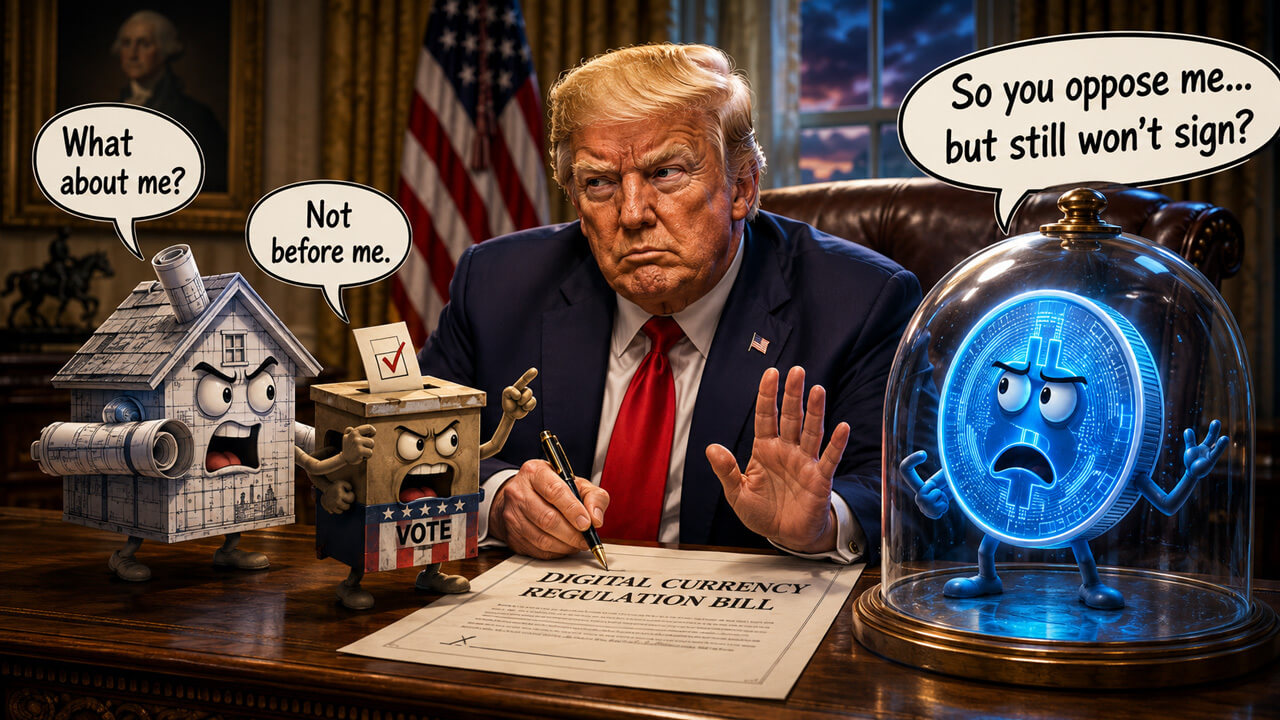
The decision placed Trump in the unusual position of blocking, at least temporarily, a measure that would codify his own opposition to a digital dollar.
The president has repeatedly described a Federal Reserve-issued central bank digital currency, or CBDC, as a threat to financial privacy and prohibited federal agencies last year from taking steps to establish, issue, or promote one.
Trump’s move did not signal a change in that position. Instead, he turned the 21st Century ROAD to Housing Act and its CBDC provision into leverage, saying he would withhold his signature until Congress passes the SAVE America Act, an elections bill requiring voter identification and documentary proof of citizenship.
He wrote on Truth Social:
Today’s Housing News Conference and Signing is hereby canceled until such time as we pass the desperately needed SAVE AMERICA ACT, which I consider to be a National Emergency.

The cancellation came hours before Trump was expected to appear at the US Capitol for a signing ceremony. It surprised lawmakers after the housing measure cleared the Senate 85-5 on Monday and the House 358-32 on Tuesday.
Those margins exceeded the two-thirds threshold needed to override a presidential veto, although it is unclear whether Republicans would maintain that level of support if forced to vote against Trump.
Trump delays a statutory CBDC Ban
The ROAD to Housing Act is primarily intended to increase the supply of homes, reduce regulatory barriers to construction, and expand access to housing finance. Its final section also includes an unrelated restriction on the Federal Reserve’s ability to issue a digital dollar.
The provision would prevent the Fed from issuing or creating a CBDC, directly or through a financial intermediary, until Dec. 31, 2030. It also states that the central bank cannot issue a substantially similar digital asset without authorization from Congress.
A CBDC would be a digital liability of the Federal Reserve made available to the public. It would differ from privately issued stablecoins such as Tether’s USDT or Circle’s USDC, which are issued by companies and generally backed by cash, Treasury securities, and other reserve assets.
The prohibition is written around central bank-issued money and would not ban private stablecoins or other open, permissionless dollar-denominated digital assets that preserve protections similar to those associated with physical currency.
The Federal Reserve has not decided to create a CBDC. It has said it would proceed only with authorization from Congress and the executive branch.
Still, the possibility has drawn sustained opposition from Republican lawmakers and digital asset groups that argue a government-issued currency could provide authorities with greater visibility into private transactions.
Trump acted on those concerns shortly after returning to office. His January 2025 executive order barred federal agencies from taking action to establish, issue, or promote a CBDC and instructed them to end initiatives related to creating one.
The order did not ban every form of technical or academic research involving digital currencies. It instead stopped federal agencies from pursuing a US CBDC as a policy project.
Because a future president could rescind or revise Trump’s order, crypto advocates have pushed for Congress to place the prohibition in federal law. The housing bill would make the restriction more durable, though it would remain temporary and expire at the end of 2030.
Trump’s refusal to sign the package, therefore, delays a legislative extension of a policy he already supports.
White House reverses its own messaging
The cancellation also undercut the White House’s promotion of the housing measure.
Earlier Wednesday, White House press secretary Karoline Leavitt described the expected signing as another example of Trump keeping a campaign promise. She said the bill would help lower housing costs and make homeownership more attainable.
Trump later minimized the measure, calling it an issue of “minor importance” compared with lower interest rates and other congressional priorities. He also criticized the involvement of Sen. Elizabeth Warren, the Massachusetts Democrat who helped negotiate the legislation as the ranking member of the Senate Banking Committee.
Asked whether he would veto the bill, Trump did not directly answer. Instead, he told reporters:
“Look, I made billions of dollars with housing. I know housing better than anybody maybe anywhere. It’s all about the interest rate. I don’t want to hurt people that own houses too.”
Lawmakers from both parties have promoted the package as one of the most substantial federal housing efforts in decades.
Following Trump’s decision, Democrats criticized him for tying those provisions to an unrelated election dispute, with Warren insisting that “we will get this bill passed.”
Sen. Mark Warner of Virginia said Trump had changed course while preparing to sign one of the most important bipartisan housing measures in years, leaving Americans without relief from rising rents and mortgage costs.
The president’s decision also frustrated some Republicans who had worked with Democrats and the administration to negotiate the package.
Before the cancellation, House leaders had presented its passage as a major affordability achievement ahead of the midterm elections.
The Voter ID standoff
Trump has conditioned his support for the housing bill on passage of the SAVE America Act, which would impose new national identification and citizenship-documentation rules for federal elections.
The legislation would require people to provide documentary proof of US citizenship when registering to vote. It would also require photo identification when casting a federal ballot and establish additional documentation rules for some absentee voters.
The House passed the bill 218-213 in February, with one Democrat joining Republicans. It has since stalled in the Senate, where Republican leaders lack the 60 votes generally required to overcome a filibuster.
Trump has pressed Republican senators to change Senate procedures or find another way to pass the legislation. Senate leaders have resisted eliminating the filibuster, and repeated attempts to advance the measure have failed.
House Speaker Mike Johnson has said Republicans may seek to place parts of the voting proposal in a broader budget measure. Trump, however, indicated Wednesday that he was not prepared to accept a compromise version.
Federal law already prohibits noncitizens from voting in federal elections. The Bipartisan Policy Center has said confirmed instances of noncitizen registration and voting are rare, while acknowledging the legitimacy of ensuring that only eligible citizens vote.
The policy group has also warned that many eligible citizens do not have ready access to the documents the legislation would require.
Opponents say the rules could prevent some citizens from registering, particularly those who lack a current passport, an easily accessible birth certificate or identification matching their current legal name.
Republicans say the requirements would strengthen election security and public confidence. Democrats and voting-rights organizations argue that the measure would create unnecessary barriers to participation while addressing conduct that is already illegal and uncommon.
Trump has elevated the issue into a condition for signing unrelated legislation, previously threatening to block other congressional priorities until the SAVE America Act reaches his desk.
Veto math leaves the CBDC bill alive
Canceling the ceremony does not automatically kill the housing bill or its CBDC restriction.
The Constitution gives a president 10 days, excluding Sundays, to sign or veto legislation after it has been formally presented. The deadline begins with presentment and not with congressional passage or the scheduling of a signing ceremony.
The housing package had not yet been formally sent to the White House when Trump canceled the event, meaning the constitutional countdown had not started. Congressional leaders retain some control over when an enrolled bill is presented to the president.
Johnson reportedly said after speaking with Trump that he still expected the president to sign the legislation within the available period. That leaves room for Trump to continue pressing senators on voting legislation without permanently abandoning the housing package.
Once the bill is presented, Trump could sign it, veto it, or take no action. If he does not return it within 10 days while Congress remains able to receive a veto, it would become law without his signature. If Congress adjourns in a way that prevents the bill’s return, Trump could block it through a pocket veto.
A formal veto would force lawmakers to decide whether to override him. The original 85-5 Senate vote and 358-32 House vote both comfortably surpassed the required two-thirds majority.
However, those votes do not guarantee an override. Republican lawmakers who supported the housing package might be unwilling to rebuke a president of their own party once he has explicitly tied the legislation to what he calls a national emergency.
For the digital asset industry, the immediate result is a delay rather than a policy defeat. Trump has not endorsed a digital dollar or withdrawn his objections to a CBDC. The Federal Reserve also has no active plan to issue one.
The post Why anti-CBDC Trump refuses to sign bill banning a digital dollar through 2030 appeared first on CryptoSlate.