
SRX Global reported a 4.3% EMJX gain that the company labels hypothetical, but its first post-acquisition disclosures still leave the central investor question unanswered: whether the strategy performs with company capital.
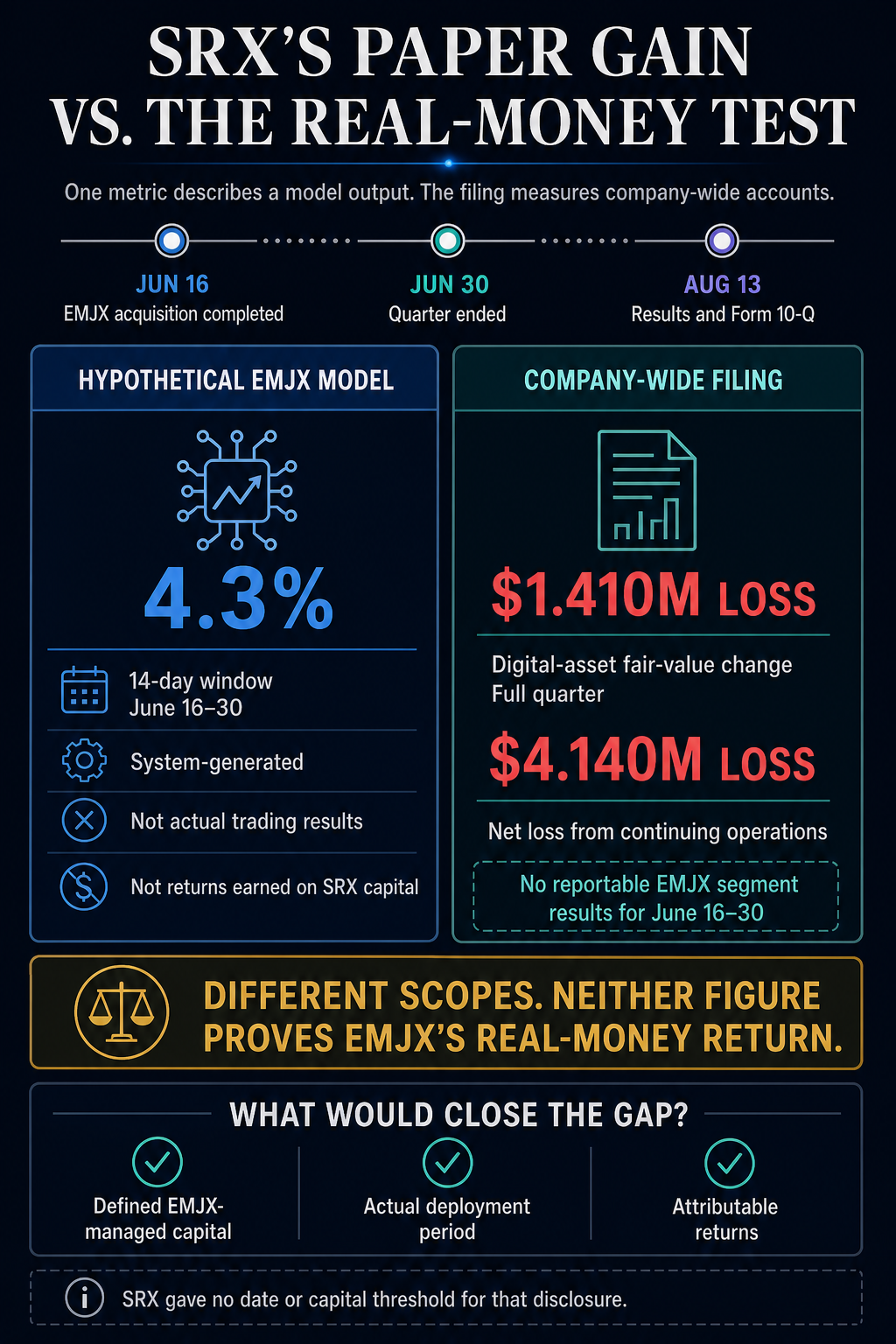
SRX completed the acquisition on June 16, two weeks before its fiscal third quarter ended. In its Aug. 13 results release, the company described the EMJX result for June 16 through June 30 as “hypothetical” and “system-generated.” It explicitly said the figure did not represent actual trading results or returns earned on capital invested by SRX.
That distinction matters because SRX had said in June, when it announced the completed acquisition, that it deployed capital into multiple high-conviction positions. The newer disclosures do not connect those positions, or any attributable returns, to the EMJX model.

What the filing actually shows
SRX’s Form 10-Q shows that its company-wide digital-asset balance began the quarter at $8.333 million. It recorded no purchases, $4.803 million in proceeds from sales, a $1.410 million fair-value loss and a $2.120 million balance at quarter-end.

Those figures do not establish that EMJX controlled the holdings or transactions. The filing separately reported no reportable EMJX segment revenue, operating expenses or other segment results for the June 16 to June 30 ownership period.
The company also recorded a $4.140 million net loss from continuing operations for the quarter. That consisted of a $3.201 million operating loss and $939,000 of net other expense, which included the digital-asset fair-value change. It is a consolidated company result, not an EMJX trading return.
The two headline figures therefore measure different things: 4.3% is a hypothetical model result over 14 days, while $1.410 million is the full quarter’s company-wide change in digital-asset fair value. The disclosure provides no basis for calculating an actual return earned by EMJX on company capital.
Management said deployment would be phased and that it would provide additional performance information after developing a meaningful history of actual capital deployment. It did not specify how much capital must be deployed or when investors should expect that track record.
For investors, the next meaningful evidence will be a defined pool of EMJX-managed capital, its deployment period and the returns attributable to it. That record would let investors compare the model’s claims with deployed-capital outcomes. Until SRX supplies those measures, the 4.3% figure describes a model output rather than a demonstrated return on invested company money.
The post How a public crypto firm’s 4.3% AI gain hides millions in balance sheet losses appeared first on CryptoSlate.