
Ethereum validators face a configuration choice next week that could determine how aggressively the network tests its next major scaling push.
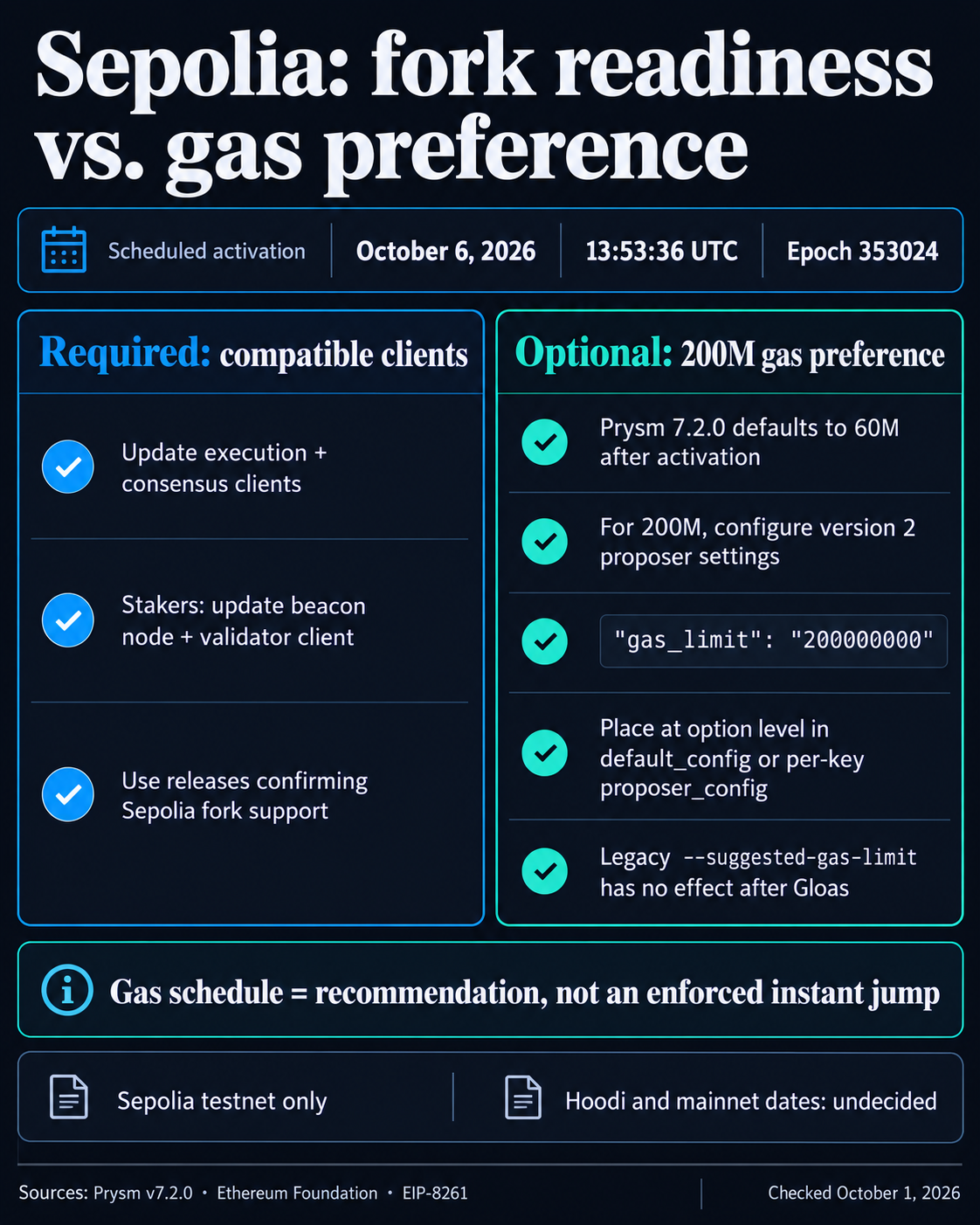
The Glamsterdam upgrade is scheduled to activate on the Sepolia testnet on Oct. 6 at 13:53:36 UTC, bringing changes designed to increase Ethereum’s execution capacity. Node operators must update both execution and consensus clients before the fork, while stakers must also upgrade their beacon node and validator software.
But simply installing compatible software will not necessarily move Sepolia toward the 200 million gas preference scheduled for the test.
Prysm 7.2.0 and Teku 26.9.1 both support Glamsterdam but will continue using a 60 million gas preference after activation unless validators explicitly change their settings, according to the Ethereum Foundation. Prysm operators must use version 2 proposer settings or the keymanager API, while Teku validators can override the default through their validator configuration.
The distinction turns Sepolia into a coordination test for Ethereum’s effort to substantially expand Layer 1 capacity.
A higher block gas limit allows more aggregate computation to fit into each block, creating room for more transactions and high-demand applications such as decentralized exchanges and other DeFi protocols. Additional capacity can ease congestion and reduce pressure on transaction fees when demand rises, though it does not make Ethereum’s underlying block times faster.
Ethereum has already been moving in that direction. Its block gas limit began rising from 30 million toward 36 million in February 2025, the first adjustment since the network moved to proof-of-stake. It subsequently climbed to 45 million before Fusaka client releases adopted 60 million as their default.
Ethereum’s 200 million ambition meets a 60 million default
Glamsterdam would push that scaling experiment considerably further, but 200 million should not be interpreted as an automatic new gas limit.
EIP-8261 introduces an optional gas-limit schedule that lets consensus clients coordinate recommended preferences at specific epochs. The proposal does not alter Ethereum’s consensus-validity rules, and blocks remain valid whether their gas limit sits above or below the scheduled value. Validators can also explicitly choose their own preference.
That means Sepolia’s realized gas limit will move gradually as validators propose blocks rather than jumping immediately to 200 million when Glamsterdam activates.
The higher target is part of a broader effort to increase the amount of work Ethereum can process without making validation impractical.
Glamsterdam combines the Amsterdam execution upgrade with Gloas on the consensus layer and introduces enshrined proposer-builder separation alongside block-level access lists, which allow clients to parallelize state reads and transaction validation. The Foundation says the changes lay the groundwork for higher Layer 1 throughput.
Ethereum has also added safeguards as capacity rises. Fusaka introduced a 16.7 million gas cap for individual transactions, limiting how much of a block any single operation can consume even as the overall block budget increases. That means higher block limits primarily create room for more aggregate activity rather than allowing individual smart-contract transactions to expand without restraint.
Sepolia will provide the first scheduled test of Glamsterdam before Ethereum developers decide how to proceed elsewhere. Hoodi and mainnet activation dates remain undecided, leaving validator participation in the 200 million preference among the signals developers can observe before taking the upgrade closer to production.
The post Ethereum is preparing a 200 million gas push as its Layer 1 scaling strategy accelerates appeared first on CryptoSlate.