
Bitcoin faces a compressed volatility test as the Federal Reserve’s rate decision lands two days before a major IBIT options expiry.
The Fed will release its policy statement at 2 p.m. ET Wednesday, followed by Chair Jerome Powell’s press conference and a fresh Summary of Economic Projections. Any move in Bitcoin will then run into Friday’s expiry of about 1.47 million options contracts tied to BlackRock’s iShares Bitcoin Trust ETF.
That sequencing gives traders a clear test of whether a macro-driven move can survive one of the largest visible concentrations of positioning in the US-listed Bitcoin ETF options market.
A sustained move outside the busiest IBIT strikes would suggest that the Fed impulse, spot demand, or broader risk positioning overwhelmed the expiry setup. A reversal back toward those strikes would increase the relevance of dealer hedging and position adjustments, though public open-interest data cannot determine the precise cause.
Bitcoin traded around $76,000 ahead of the Fed decision, placing it near the middle of the range implied by the most crowded IBIT strikes.
More than a third of IBIT positioning sits between $40 and $45
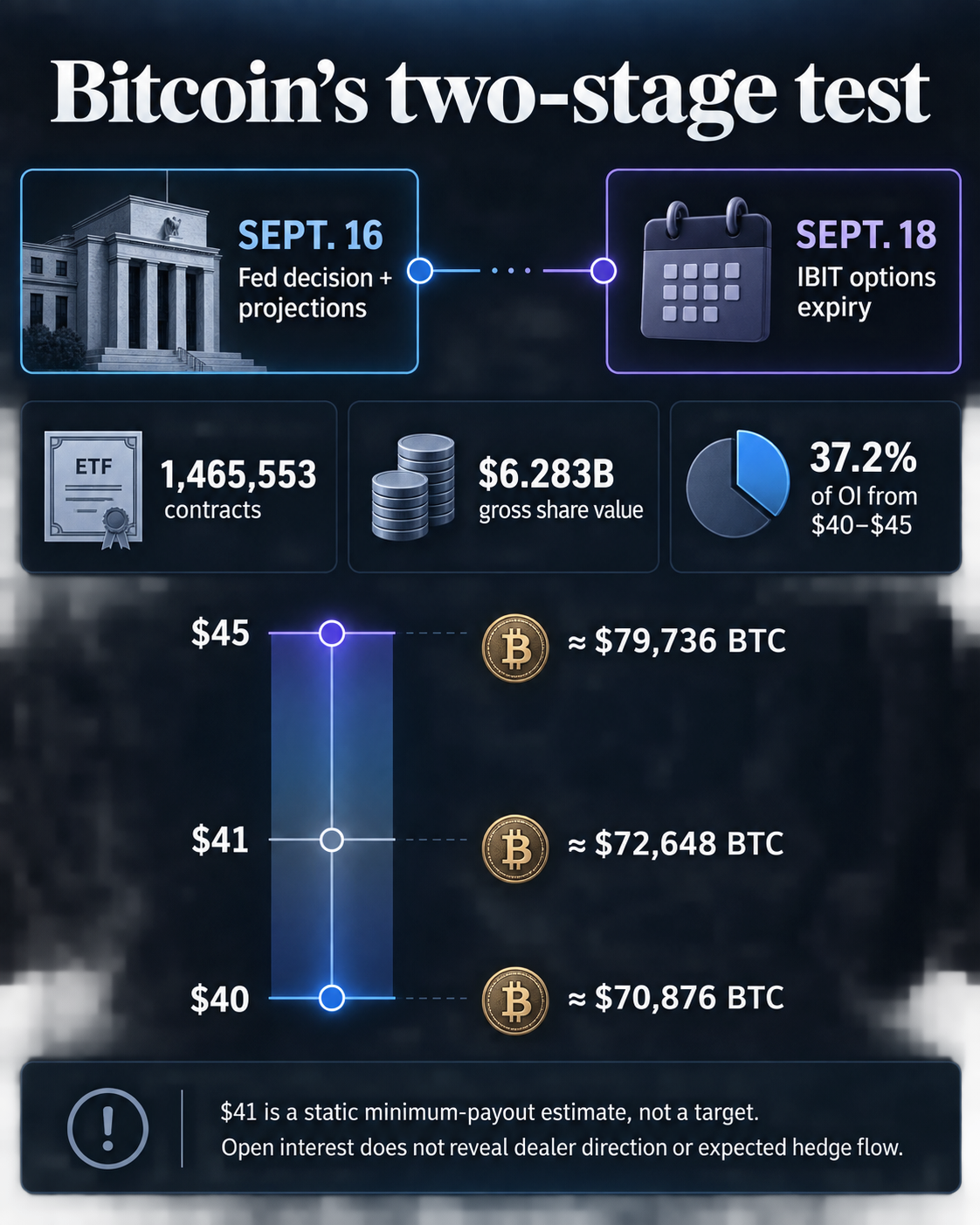
Cboe data showed 1,465,553 open contracts for IBIT’s Sept. 18 expiry, comprising 833,070 calls and 632,483 puts.
Standard equity options typically represent 100 shares each, giving the book about 146.6 million gross share-equivalents. At an IBIT reference price of $42.87, that corresponds to roughly $6.28 billion of gross underlying share value.
The figure describes the scale of the open contracts rather than capital directly at risk. It does not reveal net dealer exposure, customer positioning, expected hedge flows, or the amount of stock likely to change hands at expiry.
The concentration is more useful for identifying where the market could become sensitive to price changes.
Roughly 545,861 contracts, or 37.2% of total open interest, were clustered between the $40 and $45 strikes. The $45 strike carried the largest individual position with 141,670 contracts, while $40 held 122,979.
Those levels matter because option values and hedging requirements can change quickly as the underlying ETF moves through heavily populated strikes, particularly approaching expiry.
A static calculation of the current book found the lowest gross intrinsic value around an IBIT price of $41. That level should not be treated as a price target because the calculation excludes premiums, transaction costs, early exercise, position changes, and information about who holds each side of the trade.
Using the Coin Metrics Bitcoin benchmark at $75,961.76 and IBIT at $42.87 as a rough proportional mapping, the crowded $40-to-$45 IBIT range corresponds to Bitcoin prices of approximately $70,900 to $79,700. The $41 reference maps to roughly $72,650.
| IBIT reference | Approximate Bitcoin equivalent | Positioning context |
|---|---|---|
| $40 | $70,876 | Lower edge of the crowded strike band |
| $41 | $72,648 | Lowest gross intrinsic-value estimate |
| $45 | $79,736 | Upper edge of the band and largest strike by open interest |
Fed reaction will be tested by Friday’s settlement
The first move comes from Washington.
The Fed’s decision and updated economic projections could reset expectations for rates, growth and inflation, with Bitcoin increasingly trading alongside other risk assets during major macro events.
Friday then introduces a separate source of positioning pressure.
IBIT options are physically settled, meaning exercised contracts deliver ETF shares rather than cash or Bitcoin. Traders can close or roll positions before expiry, while others can expire worthless or be exercised and assigned.
That makes open interest a map of potential pressure points rather than a forecast of actual trading flows.
The product’s capacity for large positions also expanded this year. Cboe raised IBIT option position and exercise limits from 250,000 to 1 million contracts in May, allowing significantly larger same-side exposure than before.
The next 48 hours will show whether those concentrations remain relevant after the Fed.
If Bitcoin pushes above roughly $79,700 or below about $70,900 and holds those levels through Friday, the expiry band would carry less explanatory weight. Such a move would point toward stronger macro or spot-market forces driving price discovery.
A sharp initial break followed by a return toward the $40-to-$45 IBIT zone would put expiry-related positioning back in focus, especially if open interest shifts as traders close or roll contracts.
For options desks, market makers and leveraged traders, the distinction has immediate consequences.
A Fed-driven breakout that persists could force rapid hedge adjustments outside the existing concentration, while a return toward the crowded strikes would leave Friday’s settlement mechanics more influential over short-term positioning.
By the end of the week, traders will have a clearer answer on whether Bitcoin can carry a macro catalyst through one of the largest ETF-options expiries now sitting directly in its path.
The post Bitcoin’s Fed move could run straight into a $6.3 billion IBIT options wall appeared first on CryptoSlate.