
Bitcoin’s aggregate futures exposure fell as recently active capital gained share through Oct. 4. Younger coin cohorts tend to spend more readily during volatility, so sustained buying remains the test of how readily the market can absorb active supply.
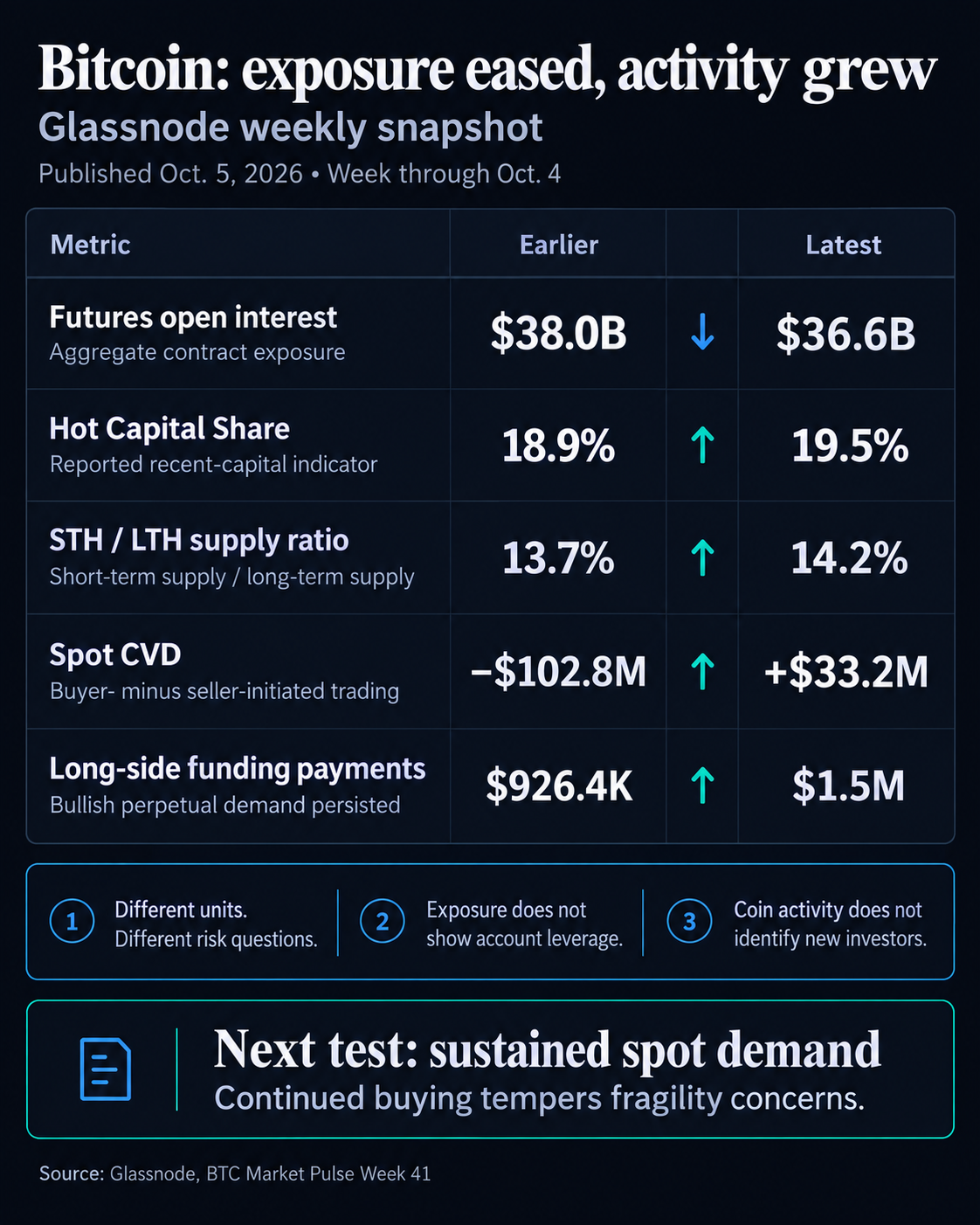
Glassnode’s Oct. 5 Market Pulse reported futures open interest declining from $38 billion to $36.6 billion. Hot Capital Share rose from 18.9% to 19.5%, while the short-term-to-long-term holder supply ratio increased from 13.7% to 14.2%.
Open interest measures outstanding futures exposure, but assessing the vulnerability of those positions also requires information about account leverage and collateral.
The remaining exposure was still near the upper edge of Glassnode’s statistical range. Long-side funding payments rose from $926,400 to $1.5 million, showing that the contraction in open interest coexisted with stronger demand for bullish perpetual exposure.
How recent activity changes the risk picture
Glassnode’s March 2025 Market Pulse glossary describes Hot Capital Share over a three-month window.
Separately, its realized-cap age-band methodology values coins at the price when they last moved, and divides each band’s value by total realized capitalization. The denominator represents the combined last-movement value of the coin supply.
When older coins move, their age resets and their realized value updates, so an established holder can reactivate dormant coins and increase recent-coin economic weight. Activity alone cannot identify first-time investors or fresh fiat deposits.
The supply ratio divides short-term-holder coin supply by long-term-holder coin supply. At 14.2%, it means about 14.2 units of short-term supply for every 100 units of long-term supply.
Glassnode’s holder classification groups addresses into entities and smooths their entity-average holding-age classification around a 155-day midpoint, excluding exchange balances.
Younger cohorts tend to spend more readily during volatility. Their growing relative presence supports continued price sensitivity, while leaving the timing and direction of future spending open.
The report’s spot cumulative volume delta, the balance between buyer- and seller-initiated trades, changed from negative $102.8 million to positive $33.2 million. The measure tracks trading aggression, so its improvement indicates a shift toward buyers without quantifying new investor capital.
Whether continued demand absorbs active supply is the next test. Sustained spot buying would temper the fragility concern, while renewed taker selling alongside deteriorating holder profitability would strengthen it.
Futures exposure and holder activity therefore need to be read together. The October snapshot shows a smaller nominal derivatives footprint alongside more recently active capital, with improving spot buying providing a counterweight. Holder sensitivity remains a separate risk to watch.
The post Bitcoin futures drop $1.4B, but spot buyers step in to help appeared first on CryptoSlate.