
President Donald Trump’s new Russia sanctions law gives Bitcoin traders another macro deadline to watch: Oct. 18.
On Sept. 18, Trump signed H.R. 5334, starting a 30-day clock for his administration to determine tariffs that could disrupt Russian energy trade and potentially feed into inflation, Treasury yields, and the dollar. Those channels matter for Bitcoin because tighter financial conditions have historically weighed on crypto markets.
The law requires the president to raise duties on all Russian goods imported into the US, including oil, natural gas, and petroleum products, by up to 500%. The figure is a ceiling rather than a mandated rate, leaving the administration considerable discretion over how aggressively it implements the measure.
A separate provision creates a potentially broader trade shock. Countries that continue making new purchases of Russian crude or natural gas after the 30-day window can face tariffs of up to 100% on all goods they export to the US if they rank among the five largest buyers. The same ceiling applies to the five largest countries deemed to be facilitating Russian oil sanctions evasion.
The legislation does not name those countries or prescribe an initial minimum tariff, making implementation more important for markets than the headline ceilings themselves.
That uncertainty turns Oct. 18 into an early test of whether the law becomes a significant macro shock or remains a limited sanctions measure.
At least 10 days before imposing or changing duties under the third-country provision, the president or US Trade Representative must provide six congressional committees with a written justification covering both the tariff rate and the methodology used to select the affected country.
The administration also retains room to soften the impact. The law includes an exception for some natural-gas purchases and allows Trump to waive duties after certifying to Congress that doing so serves US national interests.
Energy prices become the key transmission channel for Bitcoin
For Bitcoin, the first market to watch is energy.
Large tariffs on countries that remain major buyers of Russian crude or gas could alter trade flows if continued purchases become economically or politically costly.
The effect on global oil and gas prices would depend on which countries are targeted, the tariff rates chosen, and whether Russian supply is rerouted rather than removed from the market.
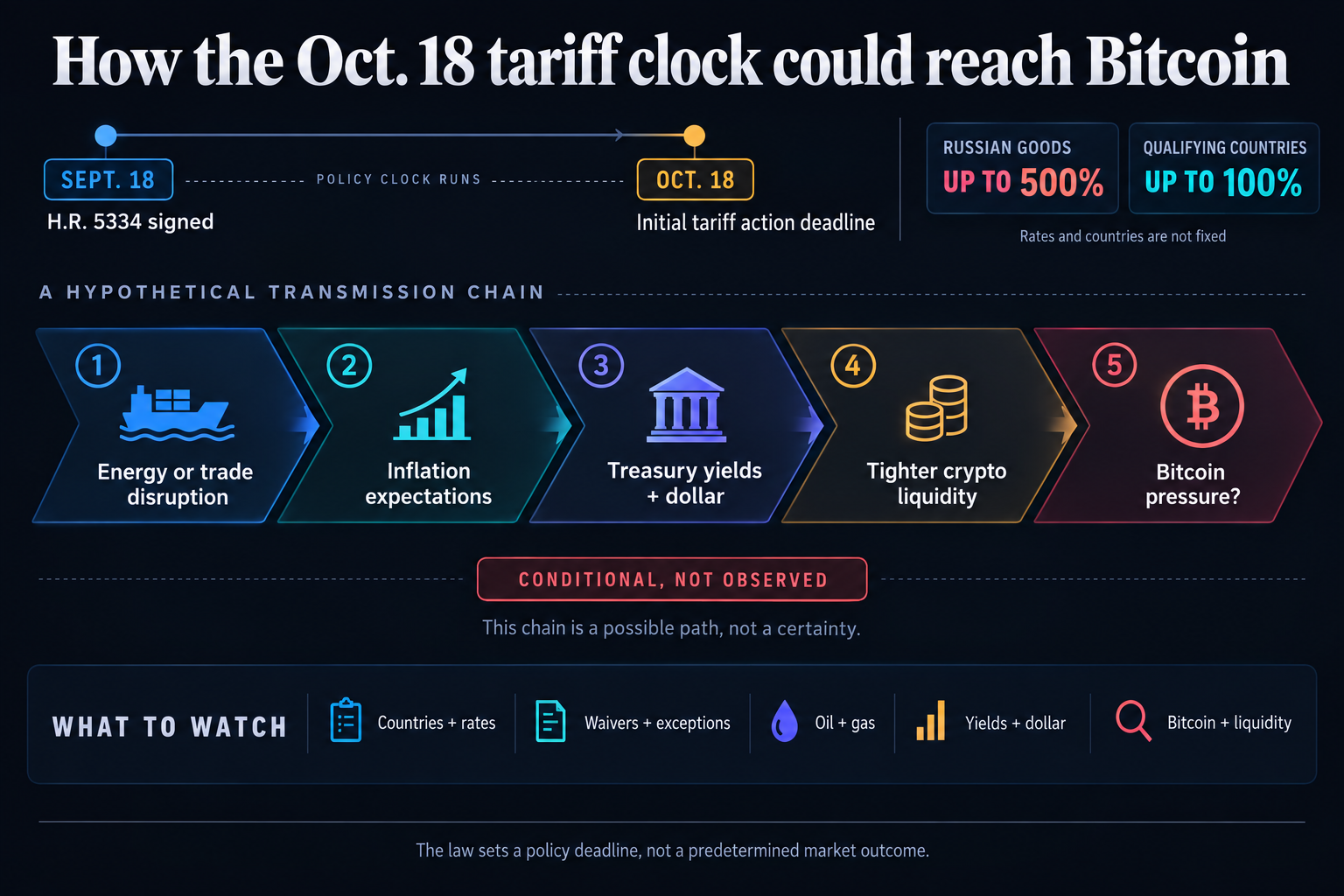
The inflation consequences become more significant if energy prices remain elevated.
Federal Reserve Governor Christopher Waller said earlier this year that prolonged increases in energy costs can spread into the prices of other goods and services as businesses absorb higher input costs. He also warned that repeated energy and tariff shocks could lift inflation expectations and complicate monetary policy.
That risk comes as the Fed already runs restrictive policy.
The central bank raised its benchmark rate by a quarter percentage point on Sept. 16 to a range of 3.75% to 4%, saying inflation remained elevated and that policy would continue to support a return toward its 2% goal.
A renewed energy-driven inflation impulse could therefore reduce the Fed’s flexibility to ease financial conditions. Higher inflation expectations can push Treasury yields upward and support the dollar, increasing the cost of capital and reducing liquidity available for risk assets.
Crypto markets have shown sensitivity to that backdrop. Research published by the Bank for International Settlements found that tighter US monetary policy was associated with falling crypto prices and lower demand for stablecoins, linking digital-asset liquidity more closely to conventional financial conditions.
That leaves traders with a sequence of signals to monitor before assigning the sanctions law a larger impact on Bitcoin.
The first will be the administration’s congressional notices, which should indicate which countries are targeted and how close tariff rates come to the statutory ceilings. Oil and gas prices would then provide the clearest measure of whether the policy is materially disrupting energy flows.
Bond yields, inflation expectations and the dollar would show whether any energy shock is beginning to spill into monetary conditions.
A mild implementation, broad use of waivers, or stable energy markets would limit that transmission. Aggressive tariffs against major Russian-energy buyers, combined with sustained pressure on oil or gas, would increase the likelihood that the sanctions regime becomes another constraint on financial conditions.
That distinction will become clearer before Oct. 18, when the administration must move from the law’s broad tariff authority to the rates and countries that determine its economic reach.
The post Bitcoin faces an October 18 test as Trump prepares new Russia tariffs appeared first on CryptoSlate.