
Iran’s reported Bitcoin tolls at Hormuz point to a new use case for crypto, sanctions-resistant trade infrastructure
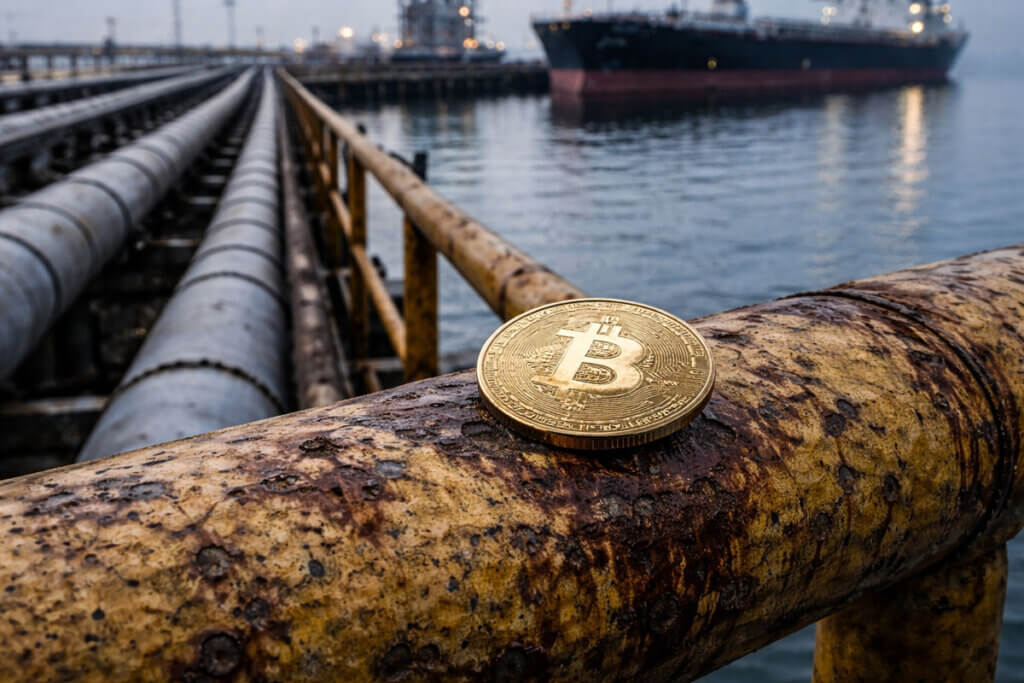
Iran is reportedly planning to charge oil tankers a Bitcoin-denominated toll for passage through the Strait of Hormuz. The move would be significant as it extends beyond price action, ideology, or adoption rhetoric.
The development places Bitcoin inside a coercive trade corridor, where settlement speed, sanctions exposure, maritime access, and state leverage converge in one of the world’s most strategically sensitive waterways.
According to the Financial Times, Hamid Hosseini, spokesperson for Iran’s Oil, Gas and Petrochemical Products Exporters’ Union, said Iran would require tankers to email authorities with cargo details, receive an assessed tariff, and then pay in Bitcoin before being allowed to pass.
Hosseini reportedly said,
“Once the email arrives and Iran completes its assessment, vessels are given a few seconds to pay in bitcoin, ensuring they can’t be traced or confiscated due to sanctions.”
The reported tariff is $1 per barrel, while empty tankers would pass freely. The same report says ships in the Gulf received an English-language radio warning that vessels attempting transit without Iranian approval would be destroyed.
Iran’s apparent objective is clear enough. It wants to convert control over a physical chokepoint into a settlement regime that sits outside the ordinary reach of dollar clearing and sanctions enforcement.
However, can Bitcoin function as the rail for the regime in a durable way, or is the claim an opening negotiating position that eventually resolves into a broader crypto stack, likely involving brokers, OTC desks, or stablecoin conversion at the edges?
The distinction carries weight because the reported mechanism arrives during a fragile ceasefire, with passage through Hormuz still contested, throughput still impaired, and shipping participants still waiting for operational clarity.
The Associated Press has described the ceasefire terms as disputed and unstable, while the FT report suggests Iran is trying to formalize a “protocol for secure passage” in coordination with its armed forces.
Within that framework, Bitcoin is less a symbol than a tool, a settlement instrument proposed at the point where legal ambiguity and commercial urgency meet.
That framing places the development in a different category from the Iran-Bitcoin cycle that has appeared in markets throughout the year. Previous episodes ran through macro channels, oil spikes, inflation fears, safe-haven narratives, sanctions scrutiny, or domestic monetary stress inside Iran.
This time, the point of contact is much narrower and more operational. A loaded tanker is a time-sensitive asset.
A delayed cargo affects refiners, freight schedules, insurance assumptions, and working capital. A settlement rail that can move outside standard banking channels becomes valuable under those conditions, even when every participant understands that value comes with compliance and political risk attached.
Hormuz has now become a testing ground for crypto amid sanctions pressure on trade infrastructure. This is not some broad shift toward Bitcoin as sovereign money.
Iran is trying to price access to a critical artery. Bitcoin appears in that design because sanctions shape which rails are available, how quickly funds can move, and how exposed counterparties are to seizure, delay, or refusal.
That is a narrower proposition, and it also carries more analytical weight.
Hormuz turns a payment rail into a geopolitical instrument
The Strait of Hormuz is uniquely suited to expose what a sanctions-resistant settlement system looks like under stress. According to the International Energy Agency, around 20 million barrels per day of crude oil and oil products moved through the strait in 2025.
The U.S. Energy Information Administration says the corridor handles roughly 20% of global petroleum liquids consumption, while UNCTAD describes it as carrying around a quarter of global seaborne oil trade, alongside major LNG and fertilizer flows.
The strategic significance of the route is well understood. What is new here is the proposed mechanism for monetizing access to it.
The FT’s reported tariff of $1 per barrel supplies a direct economic anchor. A very large crude carrier carrying 2 million barrels would face a toll of roughly $2 million.
That is a meaningful charge, yet still within a range that cargo owners could rationalize if it unlocks trapped inventory and restores movement through a congested corridor. Scale is what gives the Bitcoin angle force.
The FT cites Kpler data showing 175 million barrels of crude and refined products loaded on 187 tankers in the Gulf, and reports that industry executives estimate 300 to 400 ships are waiting to leave once safe passage becomes possible.
The same article quotes EOS Risk as saying that only 10 to 15 ships per day may be able to transit under the current process, compared with about 135 ships before the war. That is a dramatic compression in throughput.
Under those conditions, any channel that shortens delay or resolves uncertainty acquires immediate commercial value.
Pipeline alternatives are too limited to neutralize the chokepoint. The IEA estimates that only about 3.5-5.5 million barrels per day can bypass Hormuz through alternative routes, depending on availability and operating conditions.
The EIA similarly notes that bypass infrastructure from Saudi Arabia and the UAE covers only a fraction of the normal flow. That leaves maritime transit through the strait as the dominant route, which in turn gives Iran leverage over time, sequencing, and access.
This is where the settlement design becomes the central issue. Iran is attempting to move from informal wartime control to a more structured protocol in which movement depends on prior disclosure, route compliance, and payment.
A Bitcoin toll fits that architecture because it can, at least in principle, be transmitted without the direct involvement of correspondent banks, which would almost certainly refuse to process a sanctioned transaction. For Tehran, the attraction is straightforward.
A controlled crossing, a sanctioned counterparty, and a time-sensitive cargo create demand for a rail that reduces banking friction.

The commercial side of the equation is equally clear. Owners and charterers do not need to embrace the political logic behind the system to make a practical calculation around cargo movement.
They need a workable method for clearing a bottleneck. That explains why the reported development deserves attention, even if the mechanism changes in execution.
Bitcoin, in this context, is functioning as a proposed bridge between physical control and financial settlement. That shift broadens the crypto discussion, because it embeds the asset in an operational trade corridor rather than a macro narrative about reserves, inflation, or ideological adoption.
There is also a second-order consequence for Gulf power dynamics and the broader oil complex. The FT notes concern that any formalized Iranian control over Hormuz could alter the balance inside Opec+, giving Tehran something close to a veto point over rivals’ exports.
Saudi-linked voices have already signaled that “unimpeded” access would be a red line. In that sense, the demand for Bitcoin payments is part of a broader architecture of leverage.
Iran is trying to convert military and geographic position into a ruleset for passage, and it is selecting a settlement rail that reflects the financial constraints imposed by sanctions.
Bitcoin’s role is plausible, its claimed invisibility is far weaker
The part of the reported Iranian design that deserves the most scrutiny is the explanation for using Bitcoin. Hosseini told the FT that vessels would be given only a few seconds to pay in Bitcoin, “ensuring” the funds could not be traced or confiscated because of sanctions.
The compression of the payment window makes sense inside a coercive access regime. The claim about traceability stands on weaker ground.
Bitcoin is a public-ledger infrastructure. Every transaction is permanently recorded on-chain.
The entire compliance and analytics industry around crypto was built on that visibility. Bitcoin is traceable, and its tools are used by exchanges, compliance teams, and law enforcement to trace flows, identify clusters, and screen for exposure.
The concern for a sanctioned actor is therefore not whether the transfer can be seen. The concern is whether the transaction can be completed, whether the recipient can custody value without immediate interference, and whether conversion into usable liquidity can happen through intermediaries willing to assume the risk.
That difference is crucial. Sanctions resistance and opacity are separate properties.
Bitcoin can help with the first under certain conditions because it allows value transfer without a bank approving the payment. It offers far less on the second, because the trail is visible to anyone watching the chain.
The practical logic behind Iran’s proposal, therefore, rests less on secrecy than on reduced dependence on conventional financial rails. That remains meaningful, yet it is a different argument from the one embedded in Hosseini’s quote.
In its 2026 sanctions report, Chainalysis said sanctioned and illicit addresses received at least $154 billion in 2025, with state-linked actors playing a larger role in blockchain-based trade and cross-border transfers.
The same report says IRGC-linked addresses accounted for more than half of the value received by Iranian entities in Q4 2025, totaling more than $3 billion. Those figures show two things at once.
First, blockchain rails are already part of Iran-linked financial activity at a meaningful scale. Second, those rails are under continuous analytical scrutiny.
That combination supports a measured conclusion. Bitcoin as a payment rail for a Hormuz toll is plausible. Bitcoin as an invisible rail is far harder to defend.
If the system described by Hosseini is genuine, it probably relies on urgency, fragmented counterparties, layered intermediaries, and the simple commercial reality that a trapped cargo has a high cost of delay. Those conditions can make Bitcoin useful.
They do not make it unobservable.
This is also where execution risk enters. Large commercial shipping players, insurers, and commodity traders operate inside layered sanctions and compliance frameworks.
The U.S. Treasury’s OFAC maritime advisory on Iranian oil movement lays out clear red flags for maritime participants and stresses the risk of facilitating sanctioned trade. A toll payment to an Iran-linked address tied to passage through Hormuz would raise immediate questions for P&I clubs, compliance desks, brokers, and any exchange or OTC venue used to source or deliver Bitcoin.
The existence of a settlement route, therefore, does not mean the route scales smoothly across the mainstream shipping system.
The next test is whether Bitcoin holds, or a broader crypto settlement stack takes over
That leaves open the possibility that Bitcoin functions as the nominal unit while the actual workflow becomes more hybrid in practice. Payment could be quoted in BTC, routed through intermediaries, or dynamically converted from other digital assets depending on what counterparties can source and what risks they are prepared to take.
The next step is to determine whether verified evidence emerges of actual BTC settlement, on-chain receipt patterns, wallet clustering, or market color from brokers dealing with Gulf-linked counterparties.
The market context around the reported toll regime helps clarify what comes next. Oil continues to set the first-order risk signal.
Following the ceasefire announcement, Brent crude fell 16.6% to $91.11, while Bitcoin rebounded alongside the reduction in immediate macro stress. That pattern is familiar.
When Iran risk rises, oil tightens, inflation assumptions shift, and crypto reprices through the macro channel. The Hormuz toll issue adds a second layer.
It inserts Bitcoin into the physical infrastructure of trade itself.
That second layer deserves the closest attention over the coming days. A workable settlement regime needs more than a quote in a newspaper interview.
It needs counterparties, throughput, wallet infrastructure, sufficient liquidity to quickly source payments, and a surrounding services layer to handle custody, conversion, and operational errors. Maritime trade runs on procedures, documentation, and a very low tolerance for ambiguity when cargoes are large and legal exposure is high.
The system Hosseini described would need to fit into that reality.
There is also the legal setting. Under UNCLOS, ships passing through international straits enjoy a right of transit passage that shall not be impeded.
Several governments have already signaled that any Iranian attempt to formalize the control of passage would be unacceptable. That means the proposed Bitcoin toll falls within a regime whose legitimacy will be disputed even if some ships decide that the commercial need to move outweighs the political and legal objections.
In practice, contested systems often develop first through exception, then through routine, then through negotiation or rollback. Hormuz may now be entering that first stage.
For crypto markets, the broader implication is straightforward. Bitcoin’s relevance in global commerce may expand through stress points where traditional rails are constrained, rather than through conventional corporate treasury adoption or state reserve experimentation alone.
Chokepoints, sanctions zones, and politically contested trade corridors create conditions where settlement optionality has immediate value. That does not produce a universal bullish thesis.
It does, however, widen the field of real-world use cases into domains that sit much closer to geopolitical risk.
The next test is specific. Confirmation will come from evidence that Bitcoin remains the actual settlement rail once the process moves from declaration to execution.
If ships begin transiting under an Iranian approval system, yet market intelligence, broker color, or wallet analysis suggests settlement is being routed through stablecoins, OTC swaps, or off-chain arrangements, then the current framing will need refinement.
The core thesis would still hold, as crypto would continue to function as a sanctions-resistant trade infrastructure.
The asset mix would simply look different from the initial claim.
That is the most likely line of development to watch. Bitcoin has the recognizability, liquidity, and political signaling power to serve as the named instrument.
Stablecoins or intermediary structures may prove more practical at scale if participants need tighter value transfer, reduced slippage, or easier operational handling. For now, the most defensible conclusion is narrow and substantial.
Iran appears to be trying to attach a crypto-denominated toll regime to passage through one of the world’s most important oil chokepoints. If that effort holds, even briefly, it would mark a meaningful expansion in how digital assets are used, from speculative instruments and sanctions workarounds into the mechanics of coercive global trade.
The post Iran wants Bitcoin as payment to guarantee ships safe passage through the Strait of Hormuz – FT appeared first on CryptoSlate.