
Bitcoin still has not reclaimed 2017-level public attention
Bitcoin has more institutional access than at any point in its history. Spot ETFs opened a regulated route for capital that spent years on the sidelines. Corporate treasury buyers pushed the asset deeper into boardroom discussion. Reserve language entered the political and market debate with unusual force.
Price followed that shift higher. Visibility inside finance rose with it. Public search behavior still points somewhere else.

Google Trends data for worldwide web search shows that interest in “bitcoin” remains well below the late-2017 peak, even after years of ETF launches, treasury accumulation, and adoption rhetoric.
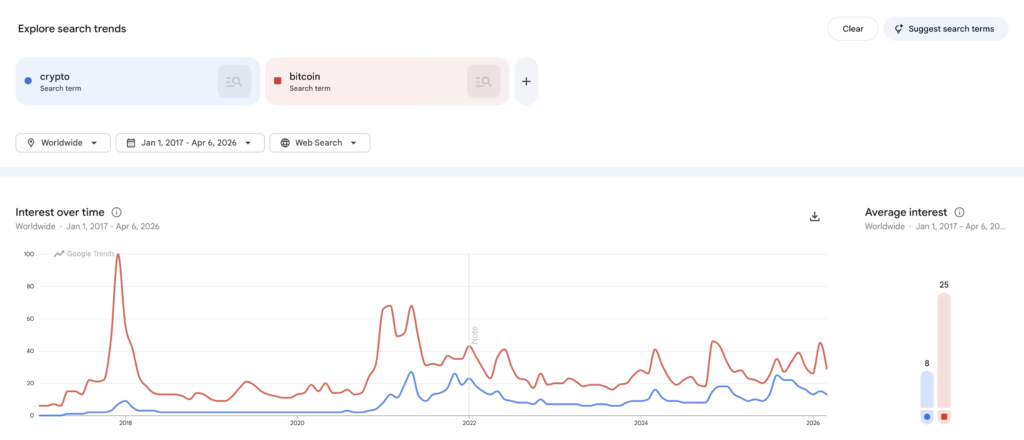
That gap is the central tension. Bitcoin expanded across institutional channels, while mass curiosity still looks subdued relative to the last full retail mania.
Why this matters: Bitcoin’s latest strength is increasingly being carried through ETFs, treasuries, and professional market infrastructure rather than the kind of mass public rush that defined earlier cycle peaks. That changes how this rally should be read, who is driving it, and what still needs to happen for claims of broad adoption to look complete.
The 2017 cycle was defined by a broad social pull. Search traffic surged. First-time buyers flooded exchanges.
The asset moved from niche financial subculture into general conversation. Today’s cycle has stronger infrastructure, deeper liquidity, and more formal ownership vehicles.
Public intensity, as measured by Google Trends, captures earlier speculative waves, which still sit far below the 2017 peak.
The result is a market that looks more mature in structure and narrower in public participation. That split has been visible for months.
In May 2025, CryptoSlate reported Bitcoin closing above $106,000 without a retail frenzy (a trend that held even at the all-time high of $126,000 in October 2025).
Days later, CryptoSlate showed retail remained sidelined even as Bitcoin traded at new highs, using app-download trends and search behavior as evidence that the cycle’s participation base looked different from that at prior peaks.
Bitcoin’s institutional ownership base is deeper. Its regulatory wrapper is stronger. Its financial integration is wider.
But, on whether Bitcoin regained the same level of mass public attention that it had in 2017? On worldwide search data, the answer still appears to be no.
Search behavior still frames 2017 as the benchmark for broad public curiosity
Google Trends methodology measures relative search interest, not raw search volume and not a direct census of how many people care about a topic.
The data is sampled, normalized, and scaled from 0 to 100 within a selected place and time range. That means the series captures comparative intensity.
It shows when a term dominates search behavior within the frame. It does not provide exact search counts.
Even with that limitation, the chart remains powerful. In a worldwide comparison from 2017 through early April 2026, “bitcoin” reached its defining high in late 2017.
Subsequent surges in 2021 and later periods fall short. Recent rebounds lift interest above local lows, while none of them approach the peak intensity of that earlier retail phase.
For anyone trying to map public engagement rather than institutional product growth, that gap carries analytical weight.
That weight grows when paired with CryptoSlate’s recent analysis. In February 2025, CryptoSlate tracked the recovery of retail demand after a January low, using smaller transactions as a proxy for non-institutional participation.
That framed a market where retail had not disappeared, yet had also not returned with the kind of force that defined prior peaks.
In May 2025, the picture was sharpened, showing record price behavior without an equivalent lift in broad retail attention.
The pattern remained visible later in the cycle. In December 2025, CryptoSlate described a Bitcoin market increasingly shaped by banks, custodians, ETFs, and institutional market plumbing.
That helps explain why price can advance while search interest remains relatively muted.
A larger share of ownership and access now sits inside formal channels. The asset can gain exposure through financial advisors, brokerage accounts, treasury policies, and fund mandates without producing the same burst of search behavior that came from millions of first-time retail entrants trying to figure out how to buy Bitcoin on an exchange.
That is the structural shift. The old cycle relied on public curiosity to pull capital into the market.
The current one can function with a larger share of capital arriving through products and institutions that sit one layer removed from retail discovery. Search behavior reflects that change.
It shows a market where legitimacy expanded faster than mass fascination.
The reserve narrative deserves harder scrutiny for the same reason. Reserve language suggests a stage of adoption that extends beyond speculative enthusiasm.
ETFs suggest mainstream financial acceptance. Both developments can be true at once.
Broad public demand still remains a separate question. Search data indicates that public attention still trails the 2017 benchmark by a wide margin.
That leaves a gap between how Bitcoin is being sold rhetorically and how it is being engaged by the wider public.
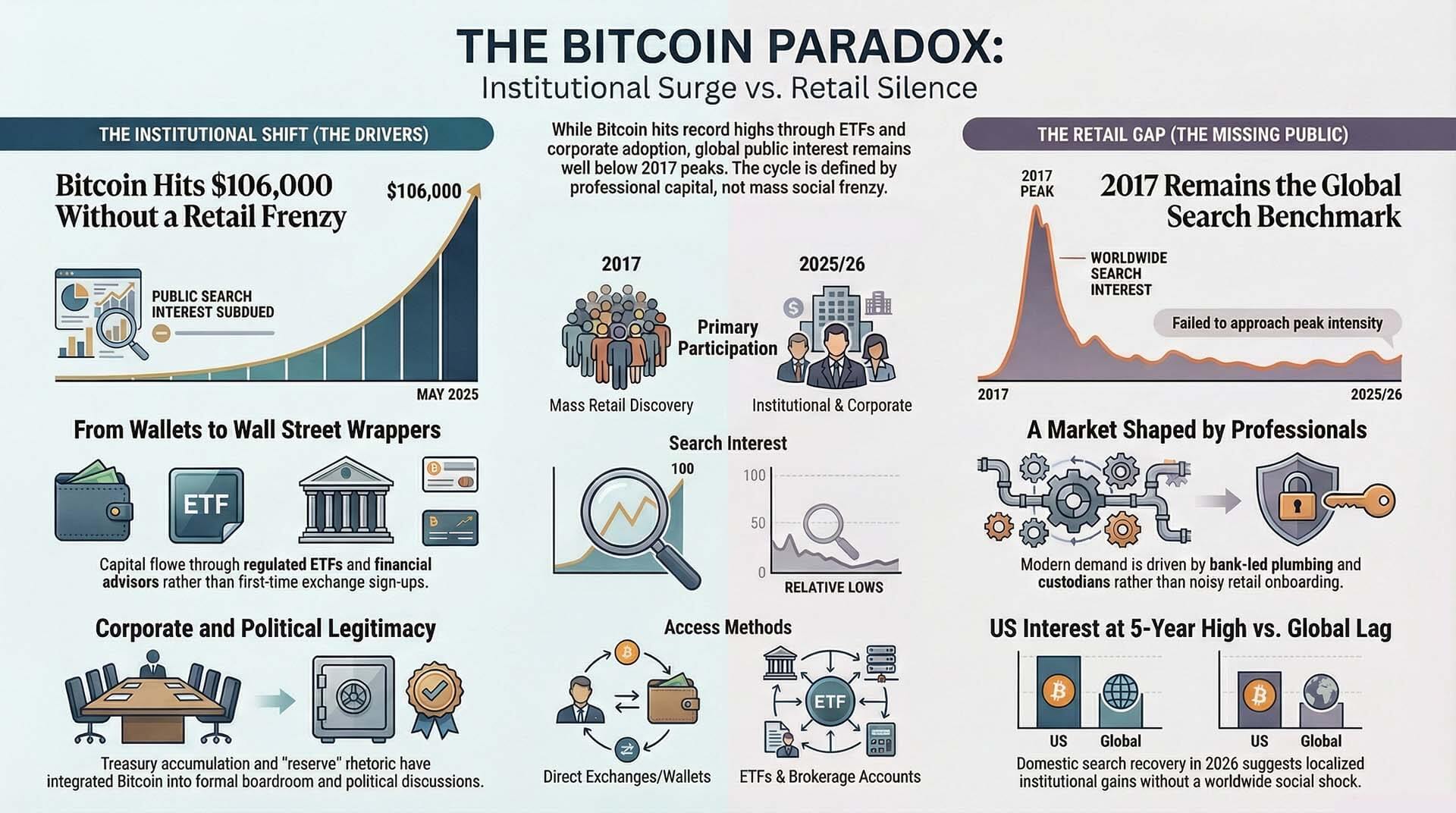
Institutional adoption has grown, while retail intensity still looks restrained
The market’s center of gravity has changed. That point is difficult to dispute.
Spot ETFs normalized Bitcoin exposure for a class of investors that prefers brokerage infrastructure, regulated custody, and familiar wrappers. Treasury accumulation added a corporate balance-sheet angle that barely existed in the 2017 cycle.
Banks, custodians, and fund managers built a professional layer around the asset that altered who holds it, how it is traded, and where demand enters the system.
That institutionalization can support higher prices without producing a matching surge in public search activity.
A portfolio manager allocating through an ETF is unlikely to generate the same search trail as a first-time retail buyer trying to understand wallets, exchanges, private keys, and market cycles. A treasury desk building strategic exposure through regulated channels behaves differently from a late-cycle retail crowd chasing momentum.
Those distinctions help explain why price and attention can diverge.
CryptoSlate’s May 2025 report on record closes without retail frenzy argued that Bitcoin’s price discovery had detached from the classic signs of a public mania.
Retail remains sidelined, reinforced by app-download trends and subdued public interest.
By December 2025, bank-led market plumbing added the structural explanation. The market had become easier for professionals to own and less dependent on noisy retail onboarding at the margin.
That is why the current rhetoric can outrun the evidence. ETF adoption is often presented as proof of broad social adoption.
Those are separate ideas. Treasury accumulation is often framed as a signal of universal conviction.
That is also a different claim. Political discussion around reserves adds another layer of symbolic legitimacy, while symbolism does not automatically produce public participation.
Search behavior still functions as a useful reality check because it captures something direct, whether people are actively seeking out Bitcoin in large numbers.
Right now, that check is sobering. Worldwide public attention remains weaker than at the prior retail apex.
That does not reduce the significance of ETFs. It does not erase Bitcoin’s integration into mainstream finance.
It does narrow the interpretation. Institutionalization advanced, and mass public re-engagement remains incomplete.
There is an additional nuance here. In February 2026, CryptoSlate reported that US Bitcoin search interest had reached a five-year high even as global search interest still lagged earlier peaks.
That split suggests the asset may be regaining attention in key financial markets without recreating the same worldwide search shock seen in 2017.
Even then, the broad point holds. Global public attention has not yet returned to its previous extremes, and the worldwide frame remains the right one for any claim about mass curiosity.
The next threshold is a broader public return, not a louder institutional narrative
Bitcoin does not need a 2017 replay to remain institutionally relevant. It already has a place inside regulated portfolios.
It already sits inside treasury and ETF conversations. Those pieces are already in motion.
Can Bitcoin turn formal legitimacy into a new phase of broad public demand, or does this cycle remain defined by professional capital operating through institutional wrappers?
The question carries weight because public attention still serves as a signal of social reach. Search interest is imperfect, while it captures a form of intent.
People search when they want to learn, transact, compare, explain, or participate. In earlier cycles, that behavior exploded as Bitcoin entered mainstream public consciousness.
The current cycle has generated large financial milestones without sparking the same level of curiosity. That gap is one of the clearest signs that the market’s character has changed.
It also puts pressure on one of the most common assumptions in the current narrative. The assumption says that ETFs, reserve language, and growing financial integration should naturally pull retail behavior back toward old highs.
That outcome has not yet appeared in the worldwide search data. Public curiosity improved from the lows.
It has not broken into a new regime. The peaks remain smaller, the spikes shorter, and the overall profile more restrained than the late-2017 benchmark.
For analysts and investors, that distinction should shape how this cycle is described. Bitcoin achieved deeper financial acceptance.
It has not yet reclaimed the same degree of public obsession. Those are separate conditions, and the market keeps confirming the split.
Capital can flow through ETFs. Treasuries can accumulate. Politicians can invoke reserves.
Search behavior can still remain far below the old mania ceiling.
That leaves the next threshold in plain view. A true return of mass retail participation would likely show up across several public-facing indicators at once.
Worldwide search interest would need to break materially higher. Exchange app demand would need to accelerate.
Retail-sized activity would need to strengthen on-chain and through broker platforms. Social curiosity would need to expand beyond finance-native circles.
Until those signals arrive together, the safer reading is that Bitcoin’s current strength is being carried more by structure than by broad public re-engagement.
That is the core point the market keeps circling around. Bitcoin won more legitimacy, more infrastructure, and more access. It still has not won back the full scale of public attention that defined 2017.
Anyone arguing that adoption has already crossed into a new universal phase needs to explain that gap, because worldwide search data continues to point to a market whose institutional rise is real, and whose mass public pull remains unfinished.
The post Bitcoin still cannot get regular people as excited as 2017 even after winning over Wall Street appeared first on CryptoSlate.