
Bitcoin’s US-session weakness is deepening as BTC prices on Coinbase trade at a $64 discount to Binance, the largest global crypto exchange
Bitcoin has lost a compounded 3.24% during US stock-market hours since Sept. 21, while prices outside that window advanced 6.07%, according to a CryptoSlate analysis of Binance BTC/USDT trading.
During this period, CryptoQuant’s Coinbase Premium Gap fell to -$64, pointing to weaker demand or heavier selling on the US-focused exchange.
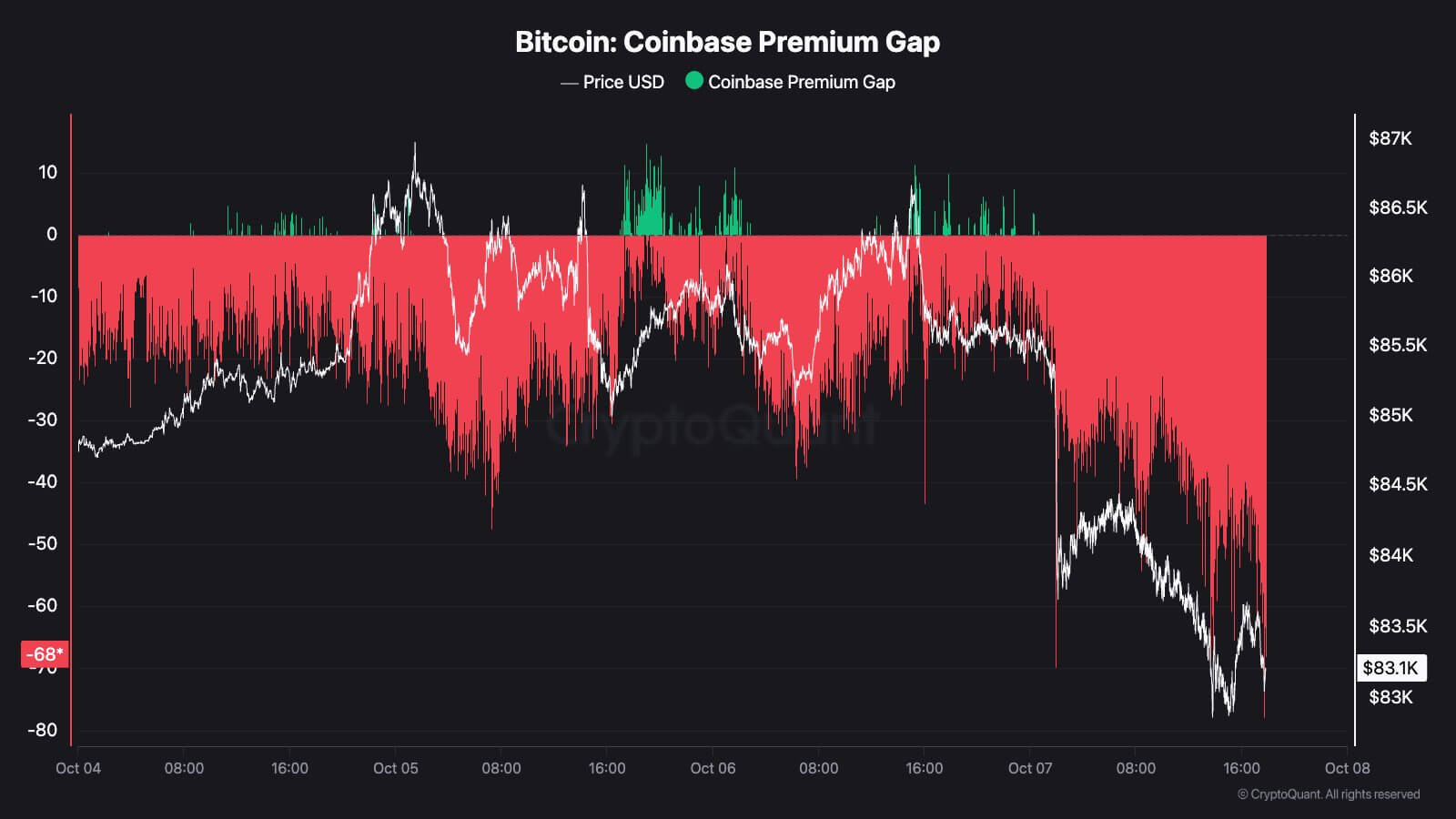
The pattern supports Glassnode’s view that the American trading session has become a source of pressure. But the losses were heavily concentrated in two sessions, while ETF flows on those dates moved in opposite directions, complicating claims of persistent institutional selling.
Two sessions drove most of the decline
Across 13 Wall Street cash sessions from Sept. 21 through Oct. 7, Bitcoin fell during eight. According to CryptoSlate’s analysis of Binance’s data, the largest declines came on Sept. 30 and Oct. 2, when prices dropped 1.86% and 2.65%, respectively, during the 9:30 a.m.-to-4 p.m. New York window.
Remove those two dates and the remaining 11 sessions produce a compounded 1.28% gain.
That influence matters because the headline 3.24% loss can otherwise suggest a steadier deterioration than the data shows. The US session was frequently weak, but much of the cumulative damage came from two sharp moves rather than a uniform pattern of selling.
The data also show that the result changes when the trading window shifts.
Starting the US session at 9 a.m. instead of 9:30 a.m. produces a compounded 4.94% loss through 4 p.m. over the same period. Starting at 10 a.m. results in a 5.41% decline.
After excluding Sept. 30 and Oct. 2, those alternative windows still show losses of 0.16% and 1.68%, respectively. That leaves the positive 1.28% remainder dependent on the exact 9:30 a.m. opening boundary.
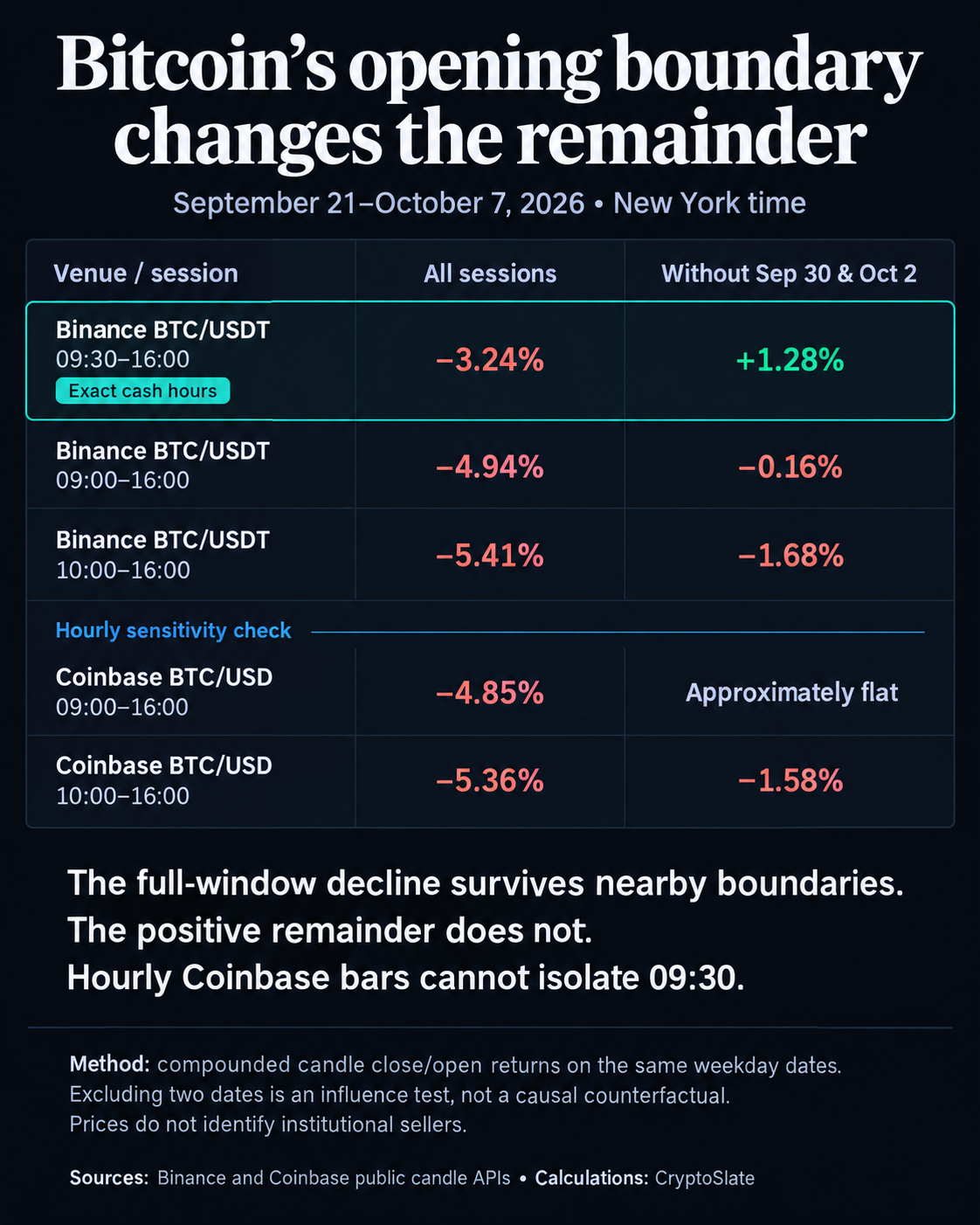
Coinbase price data points to a similar broader pattern. Bitcoin declined about 4.85% between 9 a.m. and 4 p.m. and 5.36% from 10 a.m. to 4 p.m. over the same period.
The agreement across Binance and Coinbase strengthens the timing signal while leaving participant identity unresolved.
Binance tracks Bitcoin against USDT and Coinbase against dollars, and neither venue reveals whether sellers are US institutions, retail traders, market makers or global investors active during American business hours.
Glassnode said this week that Bitcoin’s net gains since Sept. 21 have largely come outside the US session, reversing an earlier stretch when American trading hours contributed more strongly to the advance.
ETF flows fail to identify the seller
Fund flows provide the clearest challenge to a simple institutional-selling explanation.
US spot Bitcoin ETFs recorded $148.7 million of net outflows on Sept. 30, aligning with the first major US-session decline. Two days later, however, the funds attracted $189.9 million even as Bitcoin fell 2.65% during Wall Street hours.
The divergence suggests that ETF investors alone cannot explain the session weakness.
Outflows became more pronounced on Oct. 7, when the products recorded $484.9 million in net withdrawals. That shows demand from the funds has weakened at times, but daily totals still do not reveal when underlying Bitcoin was sold or which investors drove the market lower.
The mechanics of redemptions add another layer. Since regulators allowed in-kind creations and redemptions for crypto ETFs in 2025, withdrawals can involve transferring Bitcoin rather than an immediate cash sale.
That leaves the Coinbase discount as an important supporting signal rather than definitive proof of institutional selling. A sustained negative premium suggests weaker pricing on a venue closely associated with US investors, but it cannot identify the beneficial owners behind individual trades.
The next several sessions will test whether the pattern is becoming more persistent.
If Bitcoin continues to lose ground during Wall Street hours while the Coinbase discount remains deeply negative and ETF outflows build, the case for sustained deterioration in US demand would strengthen.
A recovery in US-session returns without a corresponding rebound in ETF flows would point elsewhere, potentially toward market makers, derivatives positioning, or other participants supplying Bitcoin during the American trading day.
The post Bitcoin keeps losing ground when Wall Street opens as Coinbase discount deepens appeared first on CryptoSlate.